




Home/Services/EPD & LCA
EPD · LCA · PCF

EPDs, Life Cycle Assessments and Product Carbon Footprints

From data collection and modelling to support for verification and publication.

We prepare life cycle assessments, EPDs and product carbon footprints for individual products, product families and portfolios. Data collection and preparation are structured together with you; modelling, calculation and documentation are carried out by our LCA team – software-based with LCA for Experts, Umberto and established LCA databases. For broad or dynamic product portfolios, we additionally use our client-specifically configured EPD Suite.

300+EPDs prepared
2,000+life cycle assessments
15+years of experience
Manufacturers we work for
  • Röben
  • PARADOR
  • hansgrohe
  • pro clima
  • IGI – The Global Wallcoverings Association
  • wienerberger
Environmental Product Declaration

Preparing an EPD

Environmental Product Declarations (EPDs) make the environmental impacts of a product transparent and quantifiable — based on a life cycle assessment according to EN 15804 or ISO 14025 and independently verified.

Why manufacturers need an EPD

Market and regulationParticularly for construction products, LCA-based environmental performance information is gaining regulatory importance. Which information becomes mandatory depends on the product group and the implementation status of the new Construction Products Regulation (CPR).
TendersEnvironmentally oriented tenders and public procurement require EPDs — especially in connection with green building certification systems.
BenchmarkingCompetitors already hold EPDs. Your own status quo is the basis for the ecological development of your products.
International requirementsDepending on region, product type and programme operator, different legal, normative and programme-specific requirements apply to EPDs.

EPD types

Which type fits depends on the number of products, their variance, the programme and the intended use — we clarify this as part of the EPD strategy.

Product-specific EPDDeclaration of a specific product or a clearly defined product configuration.
Average EPDAverage environmental impacts for a defined group of comparable products.
Worst-case EPDConservative declaration of a defined product group based on the least favourable relevant variant.
Representative EPDDeclaration of a defined product group based on a representative product or dataset, where the respective programme rules allow this.

Services around the EPD

EPD strategyWhich EPD type is right? Which programme operators suit your target markets and the visibility of your products? How can broad or dynamic product portfolios be declared economically?Clarify your EPD strategy →
Data collectionSupport in collecting all relevant influencing factors — including in supply chains and at subcontractors.
LCA and EPDPrepared with LCA for Experts (formerly GaBi) or Umberto and established LCA databases such as Sphera Managed LCA Content and ecoinvent.
Hotspot analysisStarting points for ecological product optimisation derived from the LCA.
BenchmarkingComparisons of different product systems — usually meaningful at component or building level.
Green building supportGreen building fact sheets for BNB, DGNB and LEED, listing in the DGNB Navigator and support towards the DGNB Navigator Label – EPDs as the basis for green building certification.

Benefits of an EPD

  • —Transparency and credibility towards customers and stakeholders
  • —Market access where EPDs are a prerequisite
  • —Extended sales and marketing opportunities
  • —Basis for ecodesign and product innovation
  • —Life cycle perspective as a circular economy foundation
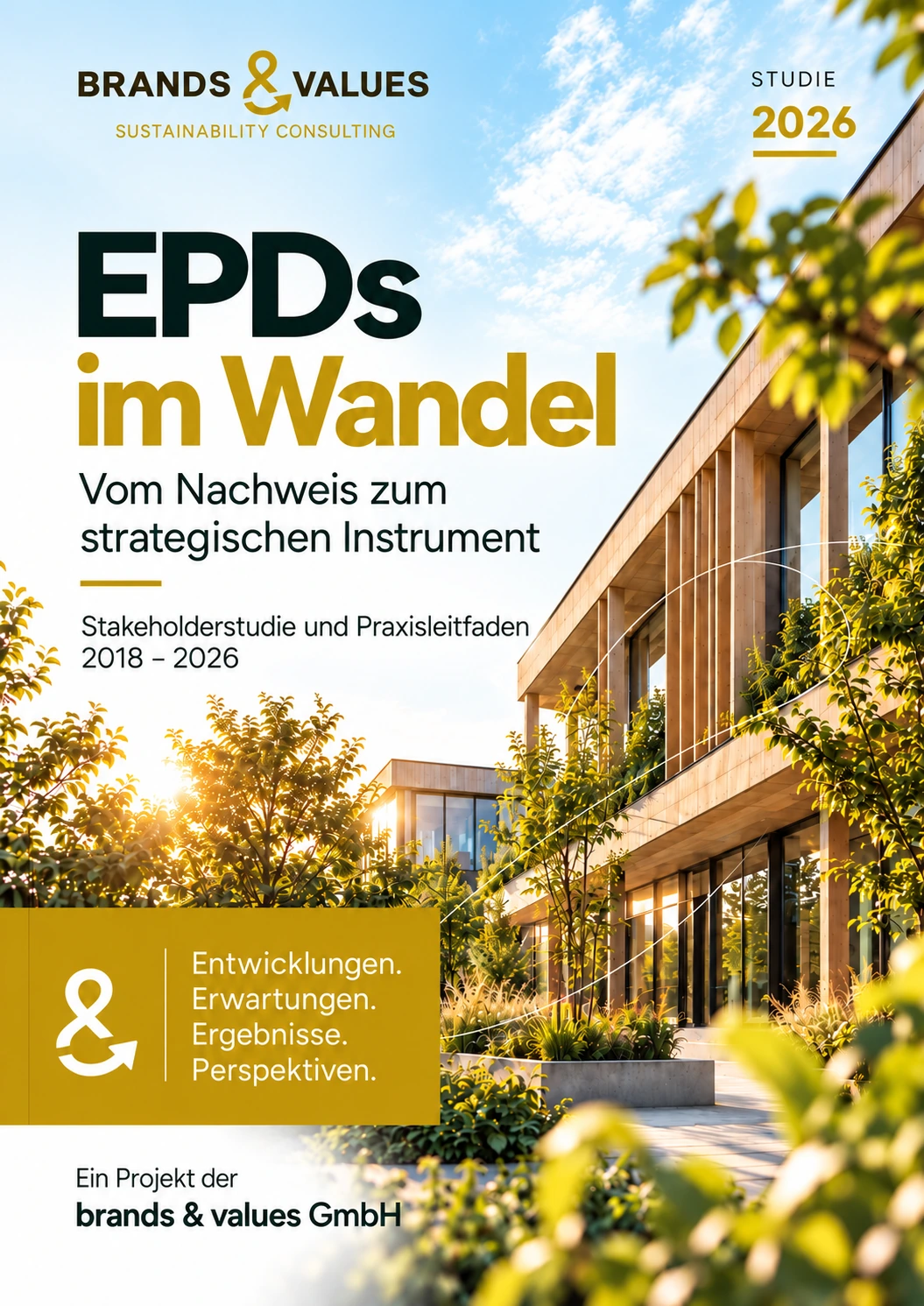
Cover of the EPD Study 2.0 “EPDs in Transition” by brands & values
EPD Study 2.0 · 2026

EPDs in Transition

From proof of compliance to strategic instrument

Our latest study shows how companies use Environmental Product Declarations today and which challenges arise around data, processes and scaling.

Life Cycle Assessment

Life Cycle Assessment (LCA)

A life cycle assessment according to DIN EN ISO 14040 and 14044 is a service in its own right — not merely the preliminary stage of an EPD. It makes the environmental impacts of a product or process visible across the life cycle and shows where optimisation should start.

Processes consideredYour own production processes as well as upstream and downstream processes: supply of energy, raw materials and intermediate products, disposal and recycling.

Services around the LCA

  • —Life cycle assessments of products and processes according to DIN EN ISO 14040 and 14044
  • —Efficient collection of all relevant influencing factors
  • —Starting points for optimising material and energy flows
  • —Comparisons of the ecological advantages and disadvantages of different product systems
  • —Eco-efficiency analysis: LCA complemented by a cost dimension

Benefits of an LCA

  • —Reliable product-related environmental information for customers
  • —Transparency about ecological hot spots in the value chain
  • —Optimisation from an ecological perspective (ecodesign)
  • —Certifications that require an LCA, e.g. CSC Concrete Sustainability Council
  • —Basis for EPDs according to ISO 14025:2026 and EN 15804
  • —Life cycle perspective in environmental management according to ISO 14001 (the standard does not require a full LCA)
Product Carbon Footprint

Calculating a PCF

The product carbon footprint captures only the greenhouse gas emissions of a product across its life cycle — from raw material extraction to disposal. It is therefore narrower in scope than a full life cycle assessment and is frequently requested directly by customers.

ISO 14067 · GHG Product Standard

Services around the PCF

CalculationCarbon footprint according to ISO 14067 or the GHG Product Standard.
Product analysisAssessment of the product and its components; identification of the relevant life cycle stages.
Data collectionData collection and preparation of the inventory.
Report and communicationDocumentation of results for customers and internal decisions.
ComparisonBenchmarking against alternatives and previous years’ values.
UpdatesContinuous monitoring and updating of the values.

Benefits of a PCF

  • —Respond to customer requirements
  • —Make product-related greenhouse gas emissions transparent
  • —Create a data basis for climate targets and reduction measures

EPD, LCA and PCF compared

EPDLife Cycle Assessment (LCA)PCFScopeEnvironmental impacts according to product category rules (PCR)Environmental impacts across the life cycleGreenhouse gas emissions onlyBasisEN 15804 · ISO 14025ISO 14040/44ISO 14067 · GHG Product StandardTypical useTenders, green building, market accessHot spots, optimisation, comparisonsCustomer requests, climate targetsResultVerified, published declarationLCA reportCarbon footprint per product
EPD
ScopeEnvironmental impacts according to product category rules (PCR)
BasisEN 15804 · ISO 14025
Typical useTenders, green building, market access
ResultVerified, published declaration
Life Cycle Assessment (LCA)
ScopeEnvironmental impacts across the life cycle
BasisISO 14040/44
Typical useHot spots, optimisation, comparisons
ResultLCA report
PCF
ScopeGreenhouse gas emissions only
BasisISO 14067 · GHG Product Standard
Typical useCustomer requests, climate targets
ResultCarbon footprint per product
EPD programmes & verification

Preparation and verification are separate

We prepare the life cycle assessment, the background report and the EPD. The review is carried out by independent verifiers; the procedure is organised by the respective programme operator. Which programme fits depends above all on your target market and the visibility you want.

brands & valuesPreparation
—Data collection—LCA modelling and calculation—EPD preparation—Preparation and support of verification
Independent verifiersVerification
—Review the EPD independently
Programme operatorEPD programme
—Organises the EPD programme, verification and publication according to its procedure
EPD programmes and programme environments we work with
IBUInstitut Bauen und Umwelt – Germany’s largest EPD programme for construction products.
EPD InternationalThe International EPD® System, Sweden.
DIN EPDDIN’s EPD programme – LCA practitioner within the DIN EPD programme.
INIES / FDESFrench database for environmental declarations of construction products (FDES).
MRPIDutch EPD programme for construction products.
B-EPDBelgian EPD programme for construction products.
EPD GlobalInternational EPD programme (formerly EPD Norge).
Orientation

Which approach fits?

Find the right EPD approach →
One productSingle EPDEPD type: specific EPD for one particular product. System boundary and methodological scope are defined separately.EPD preparation →Several similar productsGroup EPDEPD for a product group – depending on goal and data situation, e.g. as an average, worst-case or representative EPD.EPD types →Large portfolioPortfolio approachReusable models and structured product data.Product data & portfolios →Still openClarify the approachFirst assess EPD type, system boundary, programme and effort.Find the EPD approach →
Project reference
EPD · LCA · Climate · Environmental management

PARADOR

Product and corporate sustainability
Task
Declare EPDs and life cycle assessments for a broad product portfolio systematically and at scale.
Our contribution
Reusable LCA models, EPD preparation for product families and variants as well as support for verification and publication across different programme environments.
Read client statementClose client statement
„With brands & values we have a highly competent partner for sustainability. We are convinced by the integrated consulting approach. The consultants support us both in the strategy process and in the concrete implementation of sustainability in the company, for example in the form of product life cycle analyses or the introduction of an environmental management system in accordance with EMAS.“

Lubert Winnecken, PARADORLubert Winnecken, Managing Director, PARADOR · translated from German

More about EPD & LCA →
More references →
Contact

Do you need an EPD, an LCA or a PCF?

Briefly describe your product and your requirement — we will get back to you with an expert assessment of approach and effort.

Tobias Brinkmann, Managing Director brands & values
Tobias BrinkmannManaging Director+49 421 70 90 84-33Send email
